Payment processing fees can feel murky, but they come down to a few things: whether a card is tapped in person or charged online, the type of card your client uses, and extra fees that often aren’t in your quoted rate. Knowing these helps you understand your effective rate, or how much of each payment goes to fees. Below, we walk through each one and how pricing works with Jane Payments.
In this post, you will find:
- Why do online payments cost more than in-person payments?
- What are interchange fees?
- What fees aren’t included in your quoted rate?
- How do Jane Payments rates work?
- FAQ
Why do online payments cost more than in-person payments?
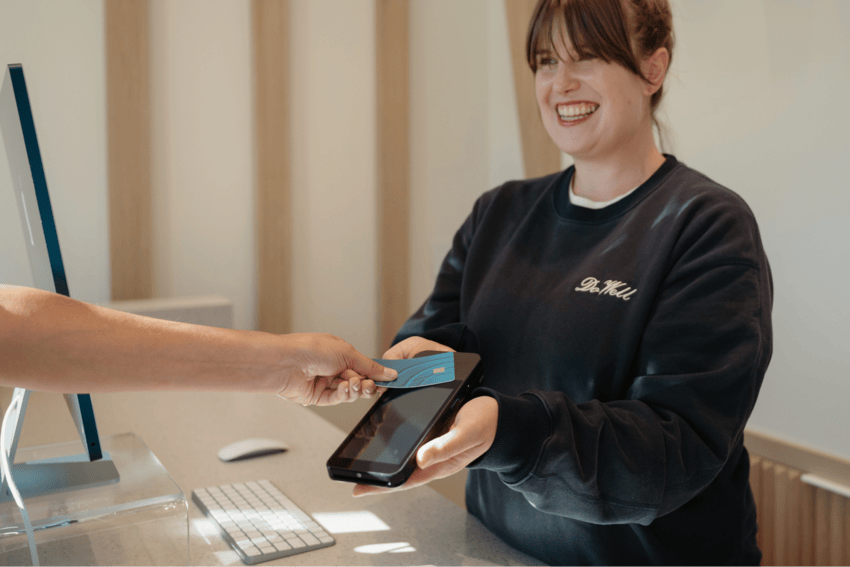
One of the biggest factors in determining your fee is how you process the payment. Taking a payment in person with a card present via a terminal costs less than charging a stored card online, even if it’s the same card and the same payment processor.
A closer look:
Terminal Payments: This is generally where you’ll see a lower rate offered. Terminal rates tend to be lower because they have the benefit of a real person having to present a real credit card directly to you. This means the risk of fraud is considerably lower, and that is accounted for in what the processor charges you.
The downside? There has to be a person with a card standing in front of you to take the payment. And we know that doesn’t always happen. ‘Oops, I forgot my wallet!’ is a very common, human mistake.
Online Payments: These fees are generally higher due to the increased protections required to receive payments online. Another reason online payments are more expensive is something called a Gateway fee. Anytime a service or software (like Jane) wants to integrate with a payment processor, a Gateway is required to facilitate the transfer of information. And you better believe that Gateway comes with a toll.
The benefit? Once your client has consented to keeping their card on file and having it charged, your whole payment experience is smoother. And bringing your wallet to an appointment becomes optional.
What are interchange fees?
Next, we need to talk about interchange fees. These are the standardized fees that each processor has to charge depending on the card. Interchange makes up the largest part of all processing fees and is the same for all payment processors. The exact rate depends on the type of card your client uses.
A closer look:
Card type: What type of card is being processed? MasterCard, Visa, or American Express? Certain cards are more expensive to process than others (we’re looking at you, AmEx ).
Card perks: What are the perks? The next factor is just how fancy that card is. Does it provide tons of perks, like lounge passes and backstage access at concerts? The more perks offered to the customer, the more a business like yours will pay to accept it.
What fees aren’t included in your quoted rate?
The rate a processor quotes you usually covers the percentage taken from each transaction, but it doesn’t always include everything you’ll pay. Some fees are added per transaction, while others show up monthly, quarterly, or only in certain situations.
A closer look:
Card assessment / brand fees: These are the fees that are paid back to the credit card company.
Per-transaction charges: Processing certain cards will include a flat fee, in addition to the percentage rate, for every transaction. For example, a credit card company might charge 1.8% + $0.10 per transaction.
Minimum processing fees: Some processors will charge a monthly fee if the amount you process doesn’t surpass a certain threshold. For example, you may pay $10 every month that you don’t process over $8,000.
PCI compliance: This is a set of security standards that you might have to pay a premium for. These fees are often charged quarterly or annually, which can make them challenging to account for.
Terminal rental fees: This is another monthly fee you might be paying if you don’t buy your terminal outright, and should be factored into your total cost.
Contracts: Some processors will lock you into a contract for a certain amount of time. If you want to switch payment processors, you may have to pay to exit the contract or continue paying a monthly fee until the contract period ends.
💡 Minimum processing fees can be especially costly for new or part-time practitioners. Pay special attention to this if you’re just starting out.
How do Jane Payments rates work?
Jane Payments uses simple, pay-per-use pricing with no contracts, and the terminal is optional. Reporting and statements for both online and terminal payments live right in your Jane account, so you can always see what you’re paying.
Because payments are built into the same place you book and chart, practitioners using Jane Payments tell us they see fewer no-shows and collect outstanding balances faster. In practice, that looks like finishing an appointment, saying goodbye to your patient, and charging their card on file at the end of the day. No swiping, no extra admin.
You can check out our current rates here, or chat with a member of our team about what might work best for your practice.

Hi, I’m Alex from the Jane Payments team. 👋
FAQ
How do Jane’s rates compare to external processors?
There are so many different options, so your best bet is to do a bit of homework (but we’ve made it a little easier). You can chat with our team to get an accurate look at your current rate and compare it to what Jane offers. All you’ll need is a current statement and a few minutes of your time.
Are Jane’s payment rates negotiable?
This is a great question! We know every dollar matters, especially in the early days. With Jane there can be some flexibility, especially for those just getting started. You can book a chat with the team to explore the options.
If you’re already using Jane, the switch to Jane Payments is a relatively simple one. And as always, the Jane Team is here to help as you consider if this is the right move for you.
And for those new to Jane, welcome! We’d love to walk you through Jane Payments but also everything else we’ve got on offer. You can book a demo with the team to learn a little more.
Thanks for sticking with this. We hope payment processing fees feel a little less murky now. If you have questions, reach out. We’re here to help.